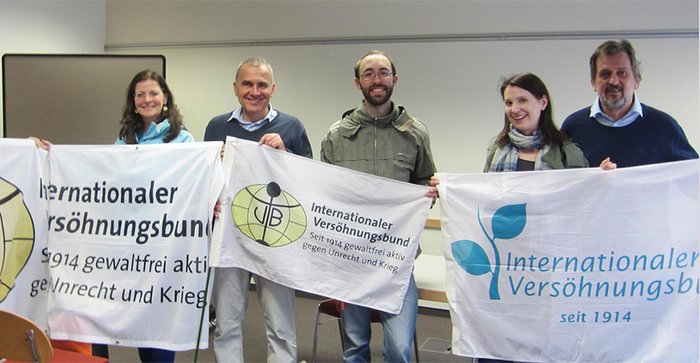
The International Fellowship of Reconciliation combines peace education, political engagement and nonviolent action. It advocates disarmament, human rights and social justice and demonstrates how resistance to violence and injustice is possible without resorting to counter-violence.
The International Fellowship of Reconciliation (IFOR/Versöhnungsbund) is one of the world’s oldest nonviolent peace organisations. It was founded in 1914 in response to the First World War and has since been committed to a world without war, oppression and structural violence – through nonviolent conflict transformation, peace education and the promotion of reconciliation. As the German branch of the International Fellowship of Reconciliation (IFOR), it connects local initiatives with global networks and thus contributes to a culture of peace.
At the heart of its work is the conviction that violence is not a sustainable solution to conflicts. The Versöhnungsbund therefore works on nonviolent conflict transformation, civil resistance, peace education and the question of how societies can ensure security without military violence. Disarmament, conscientious objection to military service and critical engagement with militarisation are also among its areas of work.
Putting Peace into Practice
The 2026 Peace Walk “Nuclear Weapons Out!” demonstrates what this work looks like in practice. In several stages, it leads from Cologne to Büchel Air Base, where US nuclear weapons continue to be stationed. The Peace Walk is organised by the Initiative Against Nuclear Weapons together with the Cochem-Zell regional group of the Versöhnungsbund. Through joint actions, discussions and a visible public presence, the initiative combines political demands with concrete nonviolent engagement. Its demands include, among other things, the withdrawal of nuclear weapons from Germany and Germany’s accession to the Treaty on the Prohibition of Nuclear Weapons. Another stage is planned for 26 September 2026.
Social conflicts and threats to democratic values are also part of this work. At its 2026 Annual Conference, the Versöhnungsbund addressed the question of how human dignity and the rule of law can be defended in the face of increasing polarisation and far-right threats. The focus was on the potential of nonviolent resistance. Around 170 people attended the conference.
Rethinking and Passing on Nonviolence
Another focus is the connection between peace work and theology. Within the Peace Theology Commission and the Versöhnungsbund’s international network, questions are explored about the significance of nonviolence for churches and Christians today. This also includes engagement with questions of war and peace, reconciliation and nonviolent resistance, as well as the development of perspectives in peace ethics.
In this way, the Versöhnungsbund combines political action with educational work, personal engagement and international networking. It creates spaces in which people can learn together, strengthen one another and seek nonviolent responses to current conflicts.
The work of the Versöhnungsbund shows that peace is not a state but a path – one that can be pursued with courage, creativity and nonviolent resistance.
The website of the International Fellowship of Reconciliation, German branch, can be found here: Versöhnungsbund
schwelle Foundation
Wachmannstrasse 79
D-28209 Bremen
Tel: +49 - (0)421 - 3032-575
> Contact